Saturday, September 21, 2013

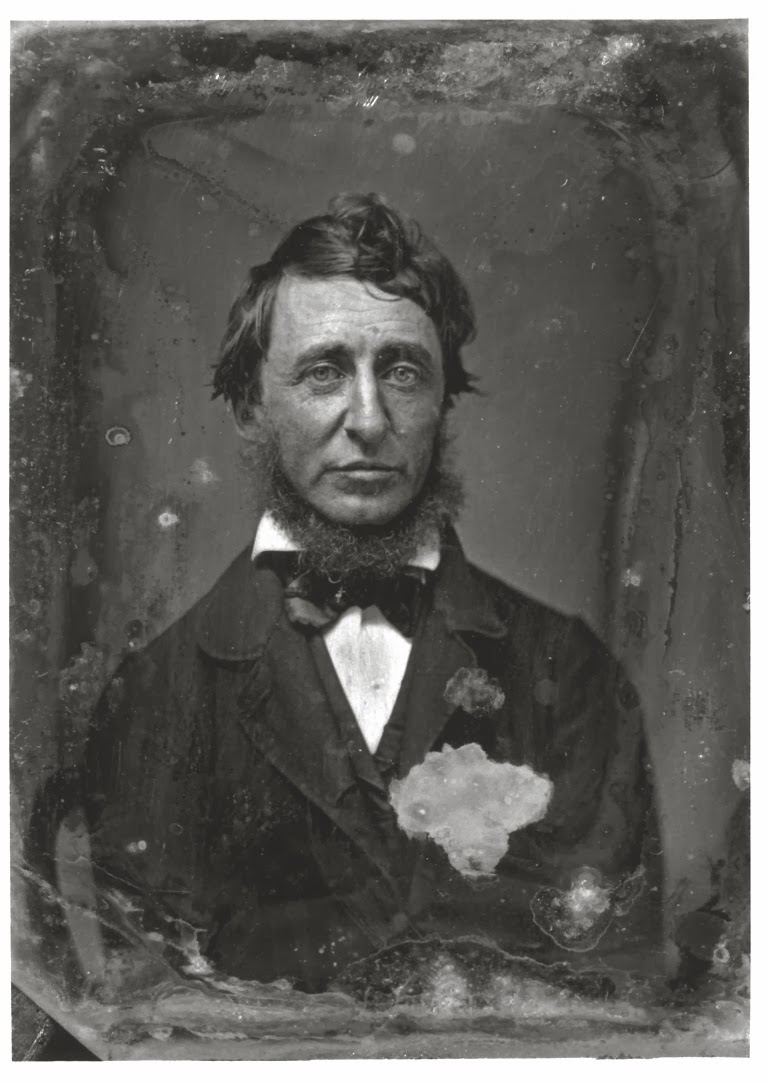
Thoreau: “I might have loved him, had I loved him less. . . .”

As an English teacher, retired, I am often asked who I thought was the greatest author.  Or who was my favorite.  The first is a bit tricky; after all, I haven’t read all the great works out there so I was hardly in a position to make such a judgment.  The second one was easy: Henry David Thoreau.  I used to reread Walden once or twice a year, and I’ve taught it several times.  But since I retired and moved to Chicago, I haven’t touched it.  Perhaps it’s living in a big city?  I once imagined that I would retire and live in a small place deep in the woods somewhere, reading and meditating and communing with Nature.  That didn’t work out, nor, at least as I see myself now, would I have liked it; I’m a big city boy at heart.

What brought all this to mind is a novel I’m reading: Thoreau in Love, by John Schuyler Bishop.  The premise of the novel is that Henry heads off to Staten Island to tutor Ralph Waldo Emerson’s brother’s children for six months, which is fact.  Thoreau, an inveterate journal keeper, must have kept a record of his time in New York, but some 200+ pages of his journal during this time have been torn out and lost to us, perhaps by Thoreau but more probably by someone after Thoreau died, perhaps acting as censor.  The novel posits what Henry did during his time in New York: among other things is his trying to come to terms with being attracted to men; in fact, in the novel, he is having an affair with a young sailor he meets on the clipper taking him to New York.

Is there any chance that Thoreau was gay (keeping in mind that the term wasn’t used then and even the concept of “being gay” would hardly have been conceivable)?  Thoreau is generally thought of as being almost asexual.  He was described by his friends as such.  He seems to have been rather a bluenose.  Certainly he never married, and when he proposed to Ellen Sewall, and was turned down, he seemed more relieved than anything.  But the great Thoreau scholar Walter Harding believed there was a very real possibility that Thoreau was, indeed, gay.  While he didn’t include that viewpoint in his biography of Thoreau, The Days of Henry Thoreau: A Biography, he later wrote an article for The Journal of Homosexuality* arguing just such a case.  Harding points out that in Thoreau’s journals, probably his most important writing, there are many references to men and masculine physical attractiveness--and few about women.  One example: “A man may be young, athletic, active, beautiful.  Then, too, his thoughts will be like his person.  They will wander in a living and beautiful world.”  At one point he describes a young man as a “brawny New Hampshire man . . . bareheaded . . . and in shirt and trousers only, a rude Apollo of a man, coming down from that ‘vast uplandish country’ to the main; . . . with flaxen hair and vigorous, weather-bleached countenance.”  What’s especially interesting about this, aside from the obvious gay undertone, is the use of “vast uplandish country,” a direct quote from Christopher Marlowe’s “Hero and Leander” in a passage talking about the beauty of Hippolytus--a man.  Finally, Harding points to Thoreau’s most famous poem, “Sympathy,” written about a young student of his, Edmund Sewall, younger brother of Ellen.  A link to the poem is provided below; it’s hard not to see this as a love poem.  Since reading Harding’s essay many years ago, I’ve always believed that Thoreau was indeed gay--in a time when such feelings could hardly be acknowledged.  That speculation has influenced my reading of Thoreau ever since.

Thoreau in Love is a good novel.  It’s plausible and well-written.  If you have any interest in Thoreau at all, I would encourage you to read it.  I would especially encourage you to read Harding’s biography also.  And if you can find a copy of the article by Harding, read that too; it’s a convincing argument.

Now, time to reread some Thoreau.  I’ll start with my favorite essay, “Life Without Principle,” and then dive back into the crystalline prose and lucid, relevant ideas of Walden.  But first, Thoreau’s poem to Edmund, “Sympathy”**.
-------------------
* Harding, Walter.  “Thoreau’s Sexuality.” Journal of Homosexuality, Vol. 21(3), 1991.
**  Thoreau’s poem “Sympathy”: http://www.thoreau-online.org/sympathy.html


Thursday, August 29, 2013

The Good, the Bad, and the So-So

In one of my first years as a teacher, I was in front of the class railing against “bad” literature; as an example, I used the ubiquitous Harlequin Romances, so beloved of the young girls in the class.  That was a mistake.  One of the young women asked me if I had actually read a Harlequin Romance.  Even as a young teacher I knew that lying to students never worked, so I had to confess, sheepishly, that I hadn’t.  She handed me one and told me to read it.  I had no choice.  I did attempt to read it, and it was even worse that I thought it might be, and I gave up after about 30 pages.  But I decided right then and there that I would no longer refer to books or authors as “bad.”  No matter how awful I thought a book to be, someone (sometimes lots of someones) liked the book, and I would only end up insulting them.  My opinions certainly had no effect on the book.

I can’t say I have stuck to that promise completely.  I’m sure I have stood in front of students and  made pronouncements about the lack of quality of Stephen King, a writer I have never been able to get through; and then there’s Anne Rice: impenetrable stuff--to me.  But clearly there are many people, including some I highly respect, who love King and Rice.  Go figure.

What brought this to mind was my recent reading of The Killing Floor, the first Jack Reacher novel by Lee Childs.  At first it was mildly interesting as the characters were developed, along with plot and setting.  But it didn’t take long before I realized I knew exactly where this novel was going; I could have outlined the entire plot after reading the first chapters.  The prose lay like cold noodles in front of me.  The Jack Reacher at the end of the novel is exactly the same as he was at the beginning.  I finished the novel, although I only scanned the last few chapters.  What made this stand out so much for me was the next book I picked up: Travels with My Aunt by Graham Greene.  The difference was evident within the first few pages: Greene’s prose can only be described as luminous, his characters vivid and unexpectedly eccentric, his mastery of detail was exquisite, the settings unique, and the plot unpredictable.  And the main character, Henry Pulling, is noticeably changed by the end of the novel: “I have escaped,” he says, meaning his whole previous life is behind him as he moves on into uncharted territory.  Reading Greene was like standing in the mountains on a sunny day, feeling a cool breeze and hearing the tumbling of a nearby stream--after standing in the dry and vacant desert of the previous book.  The experience was liberating.

There’s no way one can classify literature as good or bad or so-so without making someone unhappy.  And I can be rather a snob about the whole process--on the grounds that teaching literature for 26 years gives me some insight.  So I will continue to make judgments based on my years of reading and learning and studying works of literature.  You are welcome to disagree with me.  I sometimes disagree with myself: I hated Pride and Prejudice when I read it as an undergrad, but rereading it a few months ago I found it brilliant.

In the final analysis literary judgment is subjective and, while I have my opinions, I have to accept that others, including others whom I respect, have differing views.  I fall back on my 65 or so years of reading, but I understand everyone won’t agree with me.  I can live with that.

Tuesday, June 18, 2013

"The Undiscovered Country"


“The fear of death follows from the fear of life.  A man who lives fully is prepared to die at any time.”  ~Mark Twain

Once I turned 70, I noticed that I watched the news with a slightly different take; when there is news that some well-known person has died, I always note the birth date and age.  While I don’t actually keep score, it feels like I give a plus mark to anyone who lived longer than 70, and a minus mark to those who didn’t make it that long.  I don’t consider this ghoulish or depressing, but simply a reckoning for my own chances or odds for a long life.

I’m not afraid of death since I simply believe I will cease to exist.  But there is no doubt that I’m not ready for death: I have much more to do, and since this is my one shot at living, I want to enjoy every possible moment.  It’s the finality of death that makes living so precious and wonderful.  Philosophers have pondered the “existential void” of the finality of death; some have despaired.  For me that void is all the more reason to savor what time we have here.

The photo above is one I took in Paris at Père Lachaise Cemetery; it’s a pretty grand place, filled with the tombs of many famous people.  It would be tempting to want to be buried in such a place.  But I’m not a great author or musician, so we’ll leave the few places left there for the famous.  My ashes will go elsewhere.  For a long time I just planned on having them scattered (a euphemism for being dumped!) in Stillhouse Hollow Lake by whoever lives longer than I, followed by a beer poured in after me; and then everyone jumps in for a swim.  But lately I have given some thought to having my ashes interred at the Texas State Veteran’s Cemetery.  I’m not sure why that is, other than the cemetery is right down the road from my brother’s house and he’ll have to think about me every time he drives past.  But maybe at least a part of it is that desire to endure past death, and there will be my name, my military branch, and the fact that I’m a Vietnam veteran.  For as long as the cemetery lasts.

But even that kind of memory, or durability, won’t last forever.  I will eventually join that great mass of men and women who roll “around in earth's diurnal course, with rocks, and stones, and trees.”   I hope, when death does come, I will be able to approach it as another poet put it, and be like “one who wraps the drapery of his couch / About him, and lies down to pleasant dreams.”

Wednesday, June 12, 2013

Moving on . . .


According to Albert Einstein, “Life is like riding a bicycle.  To keep your balance you must keep moving.”  Apparently, I’ve taken this to heart.  I’m 70 years old and by my count I have moved 33 times; that is, I have only lived in each house/home for an average of 2 1/2 years.  According to Einstein I must be truly balanced.  Frankly, all that moving suggests quite the opposite.

I’ve lived in some places longer than others, of course; 2 1/2 years is an average.  I lived on the farm as a kid for 14 years, the longest location (my first three years were spent in Oklahoma City).  I left the farm to begin my moving around at age 17 as I headed to my first ill-fated attempt at college.  Before moving to Chicago I lived near Killeen, Texas, for nine years.  That’s the second longest.  The shortest, as near as I can remember, was when I moved to Oklahoma City from eastern Oklahoma and after about three months I headed to San Diego.  I wasn’t sure how to count my time in the Navy, since I virtually traveled around the world--on a ship; I settled for listing my shore assignments and counting my ship assignment as one location.

The reasons for moving are manifold: jobs, escaping jobs, lovers, the excitement of new places, and once to be near my mother as she got older and needed me more and more.  The only common denominator I can find is a general and ongoing discontent.

The thing about all this moving about is that I have never really felt that I belonged anywhere.  Even as a kid I was totally focused on getting away from the farm--and the small town nearby and the unpleasantness of most of my elementary and high school experience.  I lived in Texas four different times: twice in Dallas, once in Houston, and then in Killeen, and yet I never felt like a Texan.  Nor did I feel like an Okie either, even though I lived in that state the longest.  California likewise.  And I’ve been in Chicago almost six years, and while I love the city and moving here was one of the best moves I’ve ever made--and I have no plans to move again--I don’t feel like a Chicagoan either; I feel like an import.  No place that I’ve ever lived have I felt like I was a total and complete “fit.” 

I’m running out of time in my life.  I don’t envision any more moves, and maybe with a little more time I’ll settle into being a Chicagoan; but I’m not holding out much hope.  Why this lifelong discontent with my place of residence?  I haven’t a clue.  Maybe in another blog I’ll explore that some; but I’m already uncomfortable just thinking about it.  Maybe I’ll just concentrate on the “balance” part and leave the actual motivation alone.

Saturday, June 8, 2013

"School's Out for Summer!"


Okay, technically, my school is not out forever; I have one term to make up which I expect to do this summer.  But my four years spent studying classic literature and philosophy have been a remarkable journey, and I’ve loved almost every moment.

I’m taking about my four years in the Basic Program for Liberal Education for Adults.  What a singularly silly name: it sounds like a remedial program.  But it’s part of the University of Chicago’s Graham School of Continuing Liberal and Professional Studies.  Add those two together and that’s a mouthful.  What it is is simply a four year program for studying the Great Books.

Great Books is capitalized, as it was a compilation of important western literature and philosophy developed out of the University of Chicago in the early 20th century by, among other, Jacques Barzun and Mortimer J. Adler.  I first ran across it when my grandmother subscribed, for me mostly, to the Great Books from Harvard University arriving regularly in 51 green volumes (I have no idea where she ran across this subscription but I am grateful).  I had them for years, but now they are gone.

The program consists of three terms for each of the four years.  There are no exams nor papers to write.  There is simply a group of interested people led by a professor in the program.  The student body is varied; in my class there were three lawyers, two retired, two public school teachers, me and a retired librarian, a retired nurse with a PhD, a semi-retired priest, and a retired, although only around 50, air traffic controller, among others.  It was as varied a group of people as one could pull together.  There were Liberals, moderates, and Conservatives, religionists and pagans.

The curriculum is set by the department.  There's a link at the bottom where you can get all the information about the program including a complete reading list.  But I want to mention a few works I’ve studied and my reactions to them.

The works probably wouldn’t surprise anyone, although some are better known than others.  Sometimes the authors are well-known but the selection of the work is not what one might expect.  For example Nietzsche is on the list, but we didn’t read Thus Spake Zarathustra; rather, we read his Genealogy of Morals.  Other works are totally expected:  Machiavelli’s The Prince and Hobbes Leviathan, the Iliad, the Odyssey, and the Aeneid.  One term rotates a work of literature each year, reading either War and Peace, Don Quixote, Moby Dick, Tom Jones, or, the year I went through, Middlemarch.  We read six dialogues of Plato, but that’s hardly a surprise (The Symposium was my favorite).

Some of the works I had read before, some I had even taught.  A few I had read before and either didn’t remember or didn’t like them originally: Pride and Prejudice, for example, was a book I hated when I read it as an undergrad over 40 years ago; this time I loved it.  Some works came easy; some I struggled with; I never really got my mind around Aristotle (except his Poetics, which I read in college and later taught); his Nicomachean Ethics is mostly a blur.

If I had to pick a favorite it would Thucydides’s History of the Peloponnesian War.  But going back to Dante’s Inferno was a delight; and I was reintroduced to the amazing essays of Montaigne (about which I wrote an earlier blog).  The least favorite would probably be Aquinas and Pascal and the aforementioned Aristotle.  But I intend to revisit Aristotle to wrestle with him again.

I’ll miss my friends in the program and the regularity of the process.  Fortunately, the Basic Program offers a wide range of alumni courses, which I plan on taking as long as my mind--and my knee--holds out.

It has been voyage of great discovery, and I am grateful for the opportunity to have gone through this.  And my reward?  A certificate to hang on the wall. And an extraordinary introduction to some of the great minds of human history.
-----------------------
Web site for the Basic Program:  https://grahamschool.uchicago.edu/content/about-basic-program

Wednesday, April 3, 2013

"Priscilla" in London and Chicago


If you’ve not seen the 1994 film The Adventures of Priscilla, Queen of the Desert, you should.  It’s a delightful romp through the Australian Outback, led by three improbable drag queens (two, actually, and one transsexual); it’s a movie which, underneath its surface, deals with such themes as the trials of being different, cross-cultural bonding, being gay--and family values.  Priscilla is the bus this trio uses to drive into the heart of Australia--a pink bus (I won’t explain how it became pink as I don’t want to spoil the fun).  And in 2009, after runs in Australia and then New Zealand, the musical based on the movie opened in London; in 2011 it opened in New York; and two weeks ago it came to Chicago for a limited run.  And I was fortunate enough to see the show both in London and, this weekend, here in Chicago.

And what a delightful theatrical experience this show is.  Perhaps it’s not the stuff Broadway legends are made of, but this show is a keeper, and it gives one of the most fun-filled and delightful afternoons in the theater I’ve had since.....well, since The Book of Mormon.

Tick (Mitzi), Bernadette, and Adam (Felicia) head to Alice Springs to perform at a resort run by Tick’s wife Marion; they have long been separated, but before the separation Tick and Marion had a child, Benji.  Caught up in the gay life of Sydney, Tick has never told anyone he is a father.  Adventures follow the three men as they drive across the desert encountering improbable characters and facing dangers ranging from death in the desert from lack of water (but looking fabulous!) to ugly homophobia.  The climax comes when Tick must face his son for, basically, the first time, attempting to bond as father-son, helped by grounding from Marion, and, no matter the cost, look wonderful.

Yes, the bus is there on stage!  Slightly smaller, to be sure, but pink--and every other color and design imaginable: it’s covered it LED lights which change as needed.  There are background curtains of LED lights and divas descending from above and country music and disco balls and . . .  more, so much more.  The show is a feast for the senses.

Most importantly it affirms the simple fact that a family can consist of all sorts of arrangements.  Whether it’s two men and a transsexual in a bus or a father and son making ties over great emotional distances, families, one understands upon leaving this show, are now and forever changed and mean something different than they did for Mom and Dad way back in the dark ages.

If you’re gay, this show is absolutely life-affirming.  After the show I told Roger, one of three friends who accompanied me, that this was the gayest show I had ever seen.  And it was so in such a way that made one proud to be gay and confident that the regardless of how awful our past has been, the future will be better--no, the future will be fabulous!


Tuesday, March 12, 2013

My Need for Ritual


I don’t suppose I am much different from a good many people in my need for order and ritual in my life.  I do tend, as I have talked about in these blogs before, toward a slight OCD.  Nothing major, I don’t wash my hand obsessively, or have to skip cracks in the sidewalk (although I do wash my hands a lot and if possible I do skip the sidewalk cracks--who doesn’t?).  But I do like to know what is happening before it happens, and, as I’ve gotten older, I have lost most of my desire for spontaneity.  A little planning--okay, a lot of planning--is a good thing.

I get up at 6:00 every morning.  People, especially young people, don’t understand why I get up at a certain time when I’m retired and can sleep as late as I want.  But I like to keep regular hours and I find that I get more done in the mornings than later, so up early it is.  I check my e-mail, shower, and then head to Starbucks (yes, I wrote an earlier blog blasting what I called Starbucks’ zombies and now I am one) for morning coffee, two cups, no more no less, a banana, and, against my doctor’s orders, a pastry.  At 10:30 I join my friend Roger for whatever shopping we might want to do; or, if nothing is needed, we go for coffee, cup number 3.  After lunch I usually take a nap, 30 to 45 minutes, followed by coffee number 4 here at home.  If I get up from the nap in time, I watch Jeopardy!, just to be reminded how much I don’t know.  I’ll use the afternoon for housecleaning, studying for class, watching movies, or reading.  Don’t call or knock on my door between 5:30 and 6:00 as I’m watching my 16 minutes of evening news and 14 minutes of commercials.  Later, I may watch a little TV, catch another episode of Downton Abbey, or read.  I have a bowl of cereal around 10:00, catch the weather, shower (yes, again), and head to bed.

And Jake, my cat, is also a lover of ritual.  When I get up in the morning she expects, and always gets, her morning treats.  When I nap she usually naps with me.  Before bed she expects her 1/3 can of wet food, and will let me know if I’m running late (she hates opera night).  She gets brushed before my evening shower and is there waiting--demanding--that I not forget.  Then we have this snuggling ritual before falling asleep.

Leave the unpremeditated life to the young; I want my life planned, organized, and ritualized.